Built to stop the splash
ArD3E3: a five-fibre construction — FR viscose, polyamide 6.6, wool, para-aramid and carbon fibre — in a 350 g/m² satin weave. Wool and the smooth satin face shed liquid metal before it can drive heat into the material.

Applications · Metallurgy and welding
Stopping molten metal is one of the hardest tasks a fabric can be given. In a steel mill or a welding shop, molten-metal splash, sparks and radiant heat are the everyday working environment. So we engineered materials that take it on — from heavy welding satins to a five-fibre fabric built for molten-metal splash — to protect the health of the people who work closest to fire.
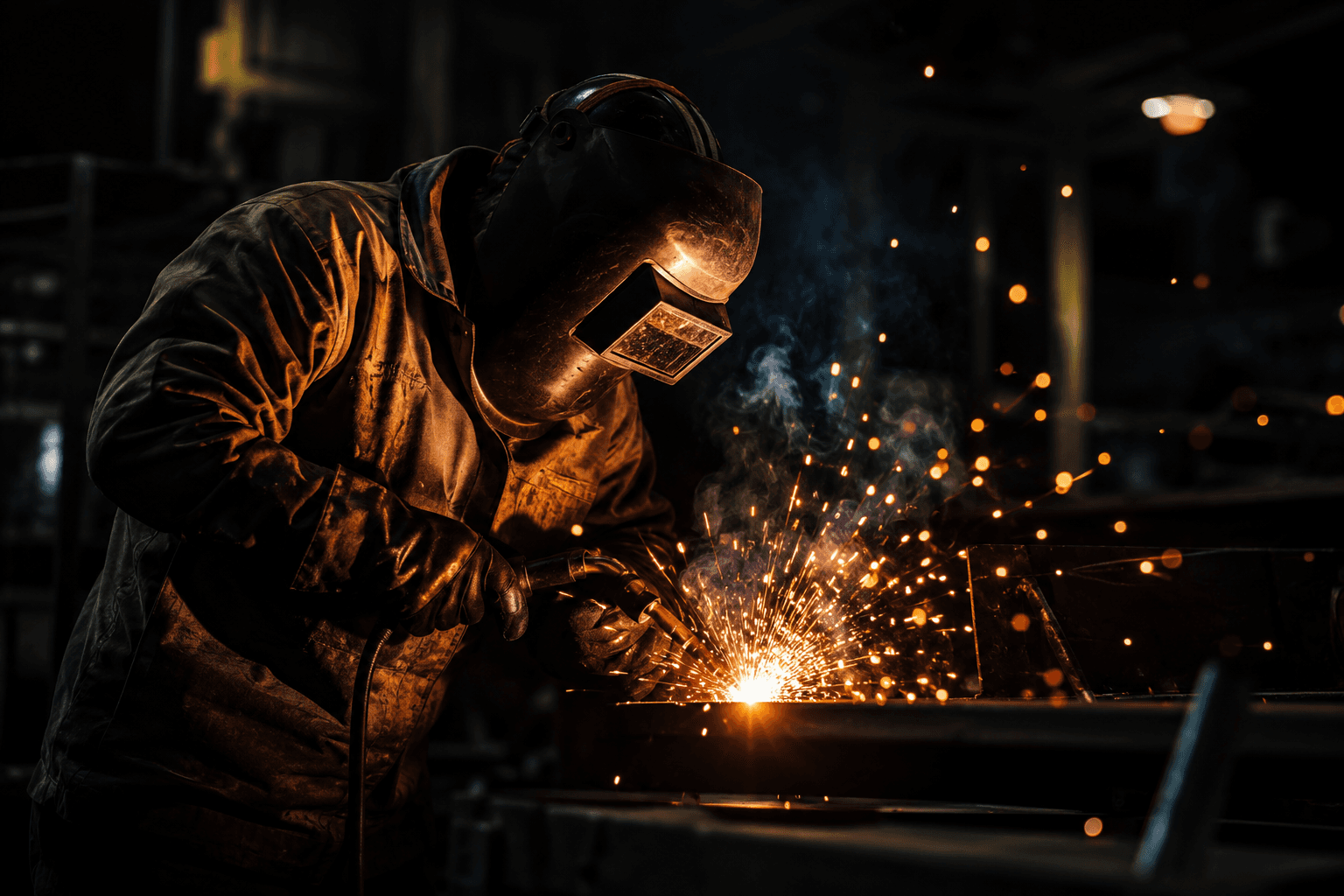
ArD3E3: a five-fibre construction — FR viscose, polyamide 6.6, wool, para-aramid and carbon fibre — in a 350 g/m² satin weave. Wool and the smooth satin face shed liquid metal before it can drive heat into the material.
Flame Pro T12 (450 g/m², 4:1 satin) and T13 (520 g/m², 5:2 satin): flame-retardant cotton with a smooth face that lets sparks and slag slide off — for the highest-exposure workstations.
Nine variants of the vat-dyed Flame Pro line: the weight matched to the workstation, from 220 to 520 g/m² — and a declared resistance of up to one hundred wash cycles that sets the cost of ownership, not the price per metre.
Aramid D0–D3, 150–260 g/m²: on contact with fire, aramid fibre chars at the surface while the material keeps its integrity — none of the secondary burns from molten polymer typical of ordinary synthetics. The D3 variant raises the para-aramid share to 23%.
Aramid Vis: 53% FR viscose in 150 and 250 g/m² wovens and in jersey, pique and fleece knits. Viscose wicks moisture during work in high temperatures — a base layer under the same FR regime as the outer garment.
The T30 and T31 variants: a 10% polyamide 6.6 share in flame-retardant cotton raises abrasion resistance in the zones that contact the structure — knees, forearms, thighs — without changing the flame-retardant regime.
54% CV FR · 20% PA 6.6 · 20% WO · 5% p-AR · 1% CF · 350 g/m² · Satin
The only fabric in the range dedicated to molten-metal splash protection — five fibres and a satin face that sheds liquid metal.
100% CO · 450–520 g/m² · 4:1 / 5:2 Satin
Heavy welding satins T12 and T13 — a smooth face that sheds sparks and slag; the heaviest weights in the line.
100% CO / CO-PES / CO-PA · 220–360 g/m² · 2:1S / 3:1S Twill
The core of the welding line: pure-cotton variants and blends with polyester and polyamide — all vat dyed, resistant to up to 100 washes.
93% m-AR · 5% p-AR · 2% CF · 150–260 g/m² · Plain / Twill
Inherently flame-retardant aramid fabrics — they do not melt on contact with heat. The D3 variant: 75% m-AR / 23% p-AR at 200 g/m².
53% CV FR · 40% m-AR · 5% p-AR · 2% CF · 150 / 250 g/m² · Plain / Twill
FR-viscose fabrics — breathable protection for layers under heavy garments and for lighter hot-work stations.
53% CV FR · 40% m-AR · 5% p-AR · 2% CF · 220–300 g/m² · Jersey / Pique / Fleece
Jersey (ArSuprem), pique (ArShirt) and fleece (Ar3iplik) in Aramid Vis chemistry — the full set of base layers under one FR regime.
Tested to standards
Composition, weight, required standards, estimated volume — we respond with an offer, a technical data sheet and test results.